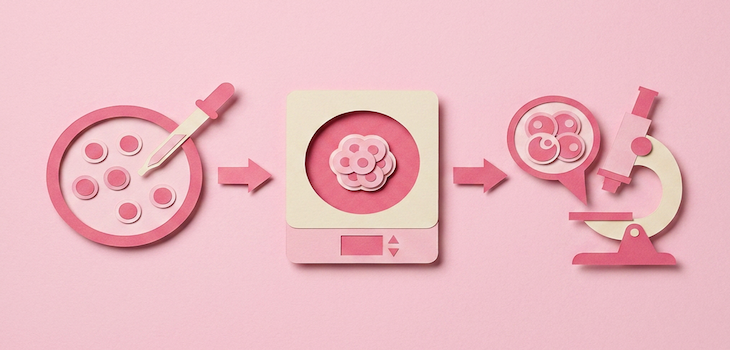
Egg retrieval can feel like a major milestone in an IVF cycle. You have completed the injections and monitoring, your eggs have been collected — and then much of the process moves somewhere you cannot see: the IVF laboratory.
Over the next few days, your embryology team will identify and handle the retrieved eggs, prepare the sperm, assess fertilisation and monitor any developing embryos.
For many patients, this period involves a lot of waiting. How many eggs were mature? How many fertilised? Are the embryos developing? Will any reach the blastocyst stage?
Understanding what happens inside the IVF lab can make these updates easier to understand — and explain why the numbers may change between egg retrieval and embryo transfer or freezing.
At Janini IVF, our in-house embryology team works alongside the clinical team throughout this stage of treatment, from egg retrieval through to embryo transfer or freezing.
What happens to your eggs after egg retrieval
What an embryologist does during IVF
How eggs are fertilised
How embryologists know if fertilisation has occurred
What happens as an embryo develops
Why not every fertilised egg becomes a blastocyst
What happens when an embryo is ready for transfer or freezing
After egg retrieval, the collected follicular fluid is passed to the embryology laboratory, where the eggs are identified and placed into carefully controlled culture conditions.
The eggs are retrieved surrounded by cells called cumulus cells. What happens next depends partly on whether conventional IVF or ICSI is planned.
If ICSI is being used, these surrounding cells are removed so that the embryologist can assess whether the eggs are mature enough for the procedure.
This is why you may hear two different numbers after retrieval: the number of eggs collected and the number of mature eggs available for treatment are not necessarily the same.
Not every retrieved egg will be mature, and this can be a normal part of an IVF cycle.
A clinical embryologist is the laboratory specialist who works with eggs, sperm and embryos during IVF.
Once your eggs have been retrieved, the embryology team becomes responsible for much of what happens in the laboratory.
This can include:
Identifying and handling the retrieved eggs
Preparing the sperm sample
Performing ICSI where this forms part of the treatment plan
Checking whether fertilisation has occurred
Maintaining appropriate embryo culture conditions
Monitoring embryo development
Preparing suitable embryos for transfer or freezing
The embryologist works alongside your fertility doctor rather than separately from them. Laboratory findings form part of the information used to plan the next stages of your cycle.
Fertilisation usually takes place using either conventional IVF or ICSI, depending on the treatment plan established for your cycle.
With conventional IVF, prepared sperm and eggs are cultured together, allowing a sperm to fertilise the egg.
With ICSI, or intracytoplasmic sperm injection, an embryologist selects a sperm and injects it directly into a mature egg.
ICSI may be recommended in certain situations, including some forms of male-factor infertility or where there are other clinical indications.
It is not simply a more advanced version of conventional IVF that every patient needs. The most appropriate fertilisation method depends on the individual fertility situation.
After IVF or ICSI, the eggs are assessed for recognised signs of fertilisation.
One of the findings the embryologist looks for is the presence of two pronuclei, often written as 2PN.
These contain genetic material originating from the egg and sperm, and their appearance is an important recognised sign of normal fertilisation at this stage.
Not every mature egg will necessarily fertilise.
This can sometimes be difficult to hear after receiving an encouraging egg-retrieval number. But the number of eggs retrieved and the number that fertilise represent two different biological stages of the IVF process.
Once fertilisation has occurred, the developing embryos remain in carefully controlled culture conditions while the embryology team monitors their progress.
During the following days, a fertilised egg begins dividing into cells.
Broadly, the journey looks like this:
Day 1: Fertilisation is assessed.
Days 2–3: The embryo continues dividing into more cells.
Day 4: Developing embryos may begin compacting into a stage known as the morula.
Days 5–6: Embryos that continue developing may reach the blastocyst stage.
Not every embryo develops at exactly the same rate, so these days are useful guides rather than a guarantee that every embryo will reach each stage at precisely the same time.
A blastocyst is an embryo that has developed for several days after fertilisation and formed distinct groups of cells.
By this stage, an embryo that has continued developing has become a more complex structure.
The blastocyst contains an inner cell mass, which contributes to the developing fetus, and an outer layer of cells called the trophectoderm, which contributes to structures including the placenta.
Depending on the treatment plan, a suitable blastocyst may then be considered for embryo transfer, freezing or further procedures such as embryo biopsy when genetic testing is being performed.
No. It is normal for the number of embryos to reduce at different stages between egg retrieval and blastocyst development.
For example, the numbers may change between:
Eggs retrieved ? mature eggs ? normally fertilised eggs ? developing embryos ? blastocysts
This reduction can be one of the more emotionally difficult parts of IVF.
If several eggs were collected, it is understandable to begin thinking of that as the number of potential embryos. Biologically, however, each egg still has several developmental stages to pass through.
Some eggs may be immature. Some mature eggs may not fertilise. And some fertilised eggs may stop developing before reaching the blastocyst stage.
This does not automatically mean that something has gone wrong in the laboratory.
Egg, sperm and embryo factors can all influence development, and not every fertilised egg has the biological potential to continue developing.
The embryology team assesses embryo development at recognised stages and records how each embryo is progressing.
Depending on the stage of development, embryologists can observe characteristics such as cell division, appearance, compaction and blastocyst formation.
The aim is not to repeatedly disturb the embryos or intervene every time one develops differently.
Instead, the laboratory maintains carefully controlled conditions designed to support development while the embryology team makes the assessments required for treatment.
Your embryos may come from the same IVF cycle and still develop differently from one another.
A blastocyst that meets the appropriate laboratory and clinical criteria may be considered for transfer, freezing or another planned procedure.
What happens next depends on your individual IVF plan.
For a fresh embryo transfer, an embryo may be selected for transfer during the same treatment cycle when clinically appropriate.
If embryos are being stored for a future frozen embryo transfer, suitable embryos can be cryopreserved using vitrification.
And when preimplantation genetic testing (PGT) forms part of the treatment plan, suitable blastocysts may undergo embryo biopsy before being frozen while testing is completed.
Your fertility and embryology teams will explain which pathway applies to your cycle.
The IVF laboratory provides the controlled environment in which fertilisation and early embryo development take place.
Embryologists cannot change the underlying genetic or biological potential of an egg or embryo. Their role is to handle eggs, sperm and embryos carefully, perform laboratory procedures accurately, maintain appropriate culture conditions and monitor development.
At Janini IVF, having an in-house embryology team allows the laboratory and clinical teams to work closely throughout the IVF cycle and review laboratory findings as part of the wider treatment picture.
A. The follicular fluid collected during egg retrieval is passed to the embryology laboratory. The eggs are identified and placed into controlled culture conditions before the next laboratory stages of treatment.
A. No. Some retrieved eggs may be immature. When ICSI is planned, the embryologist assesses egg maturity before determining which eggs are suitable for injection.
A. The embryology team assesses the eggs after IVF or ICSI for recognised signs of fertilisation. Your clinic will tell you when fertilisation updates are provided as laboratory protocols and communication schedules can vary.
A. 2PN means two pronuclei. Their presence during the fertilisation assessment is an important recognised sign of normal fertilisation.
A. Each stage of IVF represents a different biological step. Not every retrieved egg is mature, not every mature egg fertilises and not every fertilised egg continues developing to the blastocyst stage.
A. Embryos may be cultured for several days. Many IVF cycles involve culture towards the blastocyst stage around Day 5 or Day 6, although development and treatment plans vary between patients.
Once egg retrieval is over, it can feel as though your IVF cycle has temporarily moved out of your hands.
During these next few days, your embryology team is following a sequence of important stages: identifying the retrieved eggs, preparing for fertilisation, checking which eggs have fertilised and monitoring how the resulting embryos develop.
The numbers can change along the way, and that can be difficult when you are waiting for each update. But each number — eggs retrieved, mature eggs, fertilised eggs and blastocysts — describes a different stage of development rather than a final prediction of your chances.
At Janini IVF, your questions about what happens in the laboratory are part of your treatment — not something you have to figure out afterwards. If you’re considering IVF or preparing for an upcoming cycle, speak to our team about your treatment plan, what happens after egg retrieval and what you can expect from each stage of embryo development.
Book a consultation with Janini IVF:
+91-9717996655 / +91-9773926655
Related Pages
IVF treatment
ICSI
Embryo transfer
Frozen embryo transfer
Embryo grading
Last reviewed by Dr. Rutvij Dalal on Oct 01, 2026
Your email address will not be published. Required fields are marked *
If you like to have more information, let us connect. Please fill in the form below to learn about your Fertility status or scheduling an appointment with us.