This page provides an overview of IVF treatment at Janini IVF, Delhi, including evaluation, stimulation, fertilisation, and embryo transfer.
In vitro means outside the body. Fertilisation is a process in which a sperm from the male unites with an egg of the female to form a zygote or embryo. Every living animal on the planet is because of fertilisation. So, in-vitro fertilisation is nothing but the union of sperms with eggs done outside the human body in extremely controlled conditions of the embryology laboratory. It is done by a skilled scientist called “Embryologist”. At Janini IVF, the best IVF center in Delhi NCR , we have in-house Senior Embryologist to take care of all of your needs and give you a thorough and precise analysis of your infertility problem.
IVF was first done in a clinic in UK in 1978. It was done because a patient trying to conceive was found to have both her fallopian tubes blocked. Now, as you must know the fallopian tube is a part of the female body where the natural process of fertilisation occurs. If both tubes are blocked it is obvious that sperm and egg would never meet. So, scientists (Dr Robert Edwards and Dr Patrick Steptoe) thought why not make the sperm and egg meet outside the body to create an embryo. They did this by operating on the wife and retrieving her egg. The husband’s sperms are made to unite with the egg in a petri dish (conventionally a “test-tube baby” gives an idea to lay people that fertilisation occurs in a test tube. But actually it’s in a sterile dish). The resulting embryo was transferred in the patient’s uterus and after 9 months a live, healthy, term lively girl was born. Today, people know her as the world’s first test-tube or IVF baby. Her name is Louis Brown. These doctors - Dr, Edwards was just awarded the Nobel prize for this phenomenal achievement. Today, Louis Brown is more than 40 years old and has her own healthy baby which she conceived naturally - please note she did not require IVF Treatment to conceive on her own.
Meanwhile, India was not far behind. Our own scientist Dr, Subhash Mukhopadhyay created the world’s second and India’s first baby with in vitro fertilisation. Durga was born just 67 days after Louis Brown in 1978. However, this wasn’t reported officially in scientific papers. The official documentation of first IVF in India was with a baby “Harsha” born in Mumbai on 6th August 1986. Even this Harsha is now a grown adult and has her own child, conceived naturally.
Now there are many additions or advancements to this technology. Hear from the best IVF centers in West Delhi. ICSI is a process in which rather than making the egg surround by millions of sperms, one sperm is chosen, picked up in an injecting pipette by an embryologist, and is injected inside the egg which is held by a holding pipette. IMSI is, when a single sperm is magnified by a very powerful microscope. SUZI is sub-zonal injection of the sperm and is not done anymore. PICSI is just a method of trying to identify the best sperm by having them bound to a specific surface coated with a protein. So, on and so forth, but the idea is basically trying to create the best possible embryos by having the best gametes, uniting them, and then giving them the best environment (similar to maternal body which they would’ve got naturally) so that they can grow optimally and give a successful result when transferred inside the uterus after 3-5 days.
Just because IVF/ICSI conceived babies are called “Test tube babies” doesn’t mean they were kept in the test-tube for whole 9 months and couple were given a ready-made baby! That imagination is funny and strange. Far from it, currently the technology is such that we cannot culture the human embryos beyond a few days. Most human embryos are transferred not later than day 5 or 6 inside the womb/uterus. After the pregnancy establishes itself, the rest of the 9 months proceed exactly how they would proceed in a natural pregnancy. Hence, there is no difference between a natural pregnancy or an IVF pregnancy once the embryo implants. Just as how you would have had your kids naturally, similarly your kids would be just the same after the IVF procedure. Just as how you take care of yourself in a natural pregnancy (i.e. normal activity, mild exercise, proper diet, etc) the same way you need to take care in an IVF pregnancy. IVF conceptions DO NOT need extra care, or extra bed rest, or extra medical supervision. Lastly, IVF conceptions DO NOT lead to abnormal babies. Scientific literature shows that babies born out of IVF/ICSI procedure do not have higher incidence of birth defects than natural births.
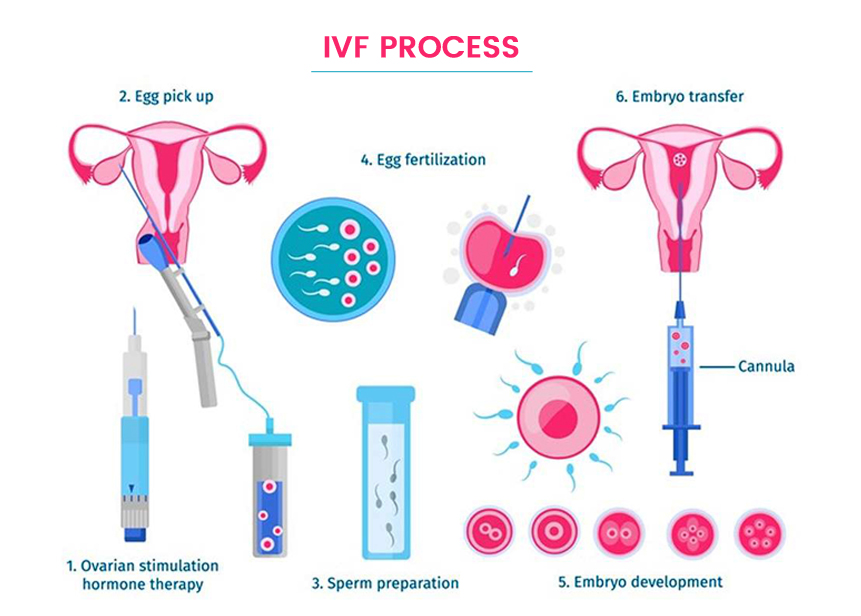
In the first consultation at Janini IVF, Dr. Dalal, the most valued IVF specialist in Delhi, will see your previous reports if any and take a detailed history. Depending on the need, we will advice you certain blood tests, perform an Ultrasound examination and ask the husband to give semen sample for evaluation. Both husband and wife are ideally evaluated together. You will also be meeting our chief Embryologist Dr. Akanksha Mishra who will be a very important person for you in this journey of taking a baby home. We will formulate the plan together and you will be thoroughly explain the way forward in a calendar chart of your convenient dates as well.
We will start an ovarian stimulation protocol to basically make the follicles in your ovaries grow. You will receive daily injections that will last for 10 to 14 days. At Janini IVF, we have a tailor-made individualised approach to ovarian stimulation such that each patient receives a protocol best fit for her case. This is done to optimise the outcome of the cycle by harvesting the best possible pool of oocytes (eggs) from a patient - both in terms of quantity and quality. While you receive the injections, the progress of follicular growth will be monitored through ultrasound scans (you will required about 3-4 scans totally) and blood hormones if needed.
The eggs that we retrieve will basically be the future embryos so it is obvious to understand that the quality and number of eggs harvested in a cycle of IVF tremendously affects pregnancy chances in that cycle. Over 15 years of experience and recipient of numerous awards, Gold Medalist Dr. Dalal would ensure that each patient at Janini IVF receives a personalised attention to the stimulation protocol she is receiving and would do the scans himself.
After the follicles become mature (size of around 18-20 mm) a ‘Trigger’ injection is given in the evening which can either be hCG or Leuprolide. It is given to make the eggs undergo final maturation. This same injection would also cause a rupture of follicles if we delay more than 36-40 hours and so, it is imperative that before they rupture themselves, we retrieve the eggs by doing the pick-up procedure.
This retrieval procedure is also called as oocyte pick-up and is done under light sedation.
How is the oocyte pick-up procedure done?
Well it is a fairly simple and quick procedure and shouldn’t take more than 20 minutes or so. It is done under sonographic guidance wherein a thin needle is passed from the trans vaginal ultrasound probe so that the fluid inside the follicles can be aspirated under negative suction. This fluid is then passed to the embryology laboratory where the expert embryologist would ‘scan’ or check the fluid under microscope for oocytes. Dr. Dalal has been instrumental in performing more than 10,000 oocyte pick-ups in his busy career. Just so that you don’t feel the stinging effect of the needle a light sedation would be given to you. You will be made to rest for a few hours in the recovery room after the procedure and would be discharged the same day evening.
The same day that the wife undergoes oocyte retrieval or pick-up, we collect the sperm from the husband. We always keep a back-up sample of his frozen with us in case of a difficulty in obtaining a sample from him. Reason being, often times the poor husband cannot perform giving a sample successfully on the day of the pick-up because of anxiety or stress. We know this happens commonly enough so we keep a back-up frozen sample. So nothing to worry even if he cannot give a sample same day. Again, a back-up sample has the advantage that if the husband has to travel or cannot be present on the day of his wife’s pickup, there is no problem.
If the husband has 0 sperm county (what we doctors call as Azoospermia), we would have usually booked him for a micro-TESE or a simple TESE procedure the same day to retrieve his testicular sperm. Micro-TESE is done under general anaesthesia, whereas a simple TESE/TESA can be done under local.
After a brief period of incubation of the eggs, they are then made to fertilise with the husband’s sperm by either IVF or ICSI technique. Our lab directory Dr. Akanksha Mishra is an expert who have trained hundreds of junior Embryologists in her career. An Oxford graduate, she ensures the maintenance of perfect laboratory conditions such that the egg and sperms when incubated have exactly the same environment surrounding them that mimics the female reproductive system so that we get the best quality embryos. We, at Janini IVF, use a “matcher” system and also “Double-witnessing” protocol to ensure that there is no mistaken sample used for any of the patients. In our hands, the exemplary protocols ensure elimination of human errors completely.
The embryos are cultured till day 3 or day 5, depending on the number and quality of embryos found at each step of the way. Going for a day 5 or blastocyst transfer has its own advantages and it is particularly beneficial to those couples who’ve had previous IVF attempt failures. At every step of the way, you will receive a communication from us notifying you about the progress of your case and how your embryos are formed. Going for a day 3 versus day 5 transfer (or sometimes both day 3 and day 5 together called sequential transfer) would be a joint decision taken by all of us together keeping best interests for you in mind.
Along with the day of transfer, we will also decide on the number of embryos to be transferred. At Janini IVF, our logo is “Scientific. Transparent. Affordable” and that is exactly what we are. At every step of the way, you will be informed about the progress of your case, right from the number of follicles developing, the eggs retrieved, number of M2 or mature eggs, embryos formed and number of surplus embryos remaining after transfer for freezing.
Embryo transfer, although being an important and skilful technique, is completely painless and quick. One of the major parameters that determine success in an IVF cycle is the clinician doing the embryo transfer and his expertise in doing it. Dr. Dalal at Janini IVF, gold medalist and one of the few FNB degree holders in the country, has an extensive experience of performing more than 10,000 embryo transfer in his career so far. All these little yet important factors play a role in bringing the excellent success rates that we, at Janini IVF have.
Providing the best infertility treatment in Delhi, Embryo transfer is done under ultrasound guidance. There is no need of anaesthesia or bed rest and you will be up and about and go home immediately. Of course, all extra remaining embryos will be safely frozen by us and they will all carry a proper identification associated with you. Before going home, you will be given a documented summary mentioning all details about the transfer including a picture of embryos that were transferred. You will also be given a prescription of the medicines that you need to take.
We will prescribe you certain important medicines called “Progesterone” that you need to take religiously for the next 15 days until we do the pregnancy test. This medicine would be in the form of oral tablets and/or injections and/or vaginal pessaries. Make sure you take them as ordered and do not miss any dose. No extra precautions are needed after embryo transfer apart from following your usual routine. It makes sense to not lift heavy weights or indulge in strenuous exercise. But apart from that, nothing else needs to be done. No restrictions on food either.
After about 15 days there will be a urine or blood test that will confirm pregnancy based on which we will determine further plan of action.
There is no set number - it depends on the ovarian reserve of the woman. Usually, receiving 12-16 oocytes is considered to be a good number, but in women with advanced age or poor ovarian reserve, this number could be as low as only 1 or 2. Even then, we can get a successful pregnancy. But yes, the more the number of good quality eggs retrieved, the better.
Most of the injections used in IVF are small, painless injections and all you will feel is a mild prick.
Both are methods of fertilising the egg with the sperm. Both are part of ART or assisted reproductive technology treatment. Whereas IVF involves placing egg and lots of sperm together in a petri dish, ICSI involves injecting a single sperm into a single egg. Thus, IVF resembles natural conception somewhat whereas ICSI is more advanced and technical procedure. When there is a severe male infertility for e.g. severe oligospermia (sperm count < 5 million/ml) or Azoospermia (complete absence of sperm in ejaculate and we have only few sperm from testicular extraction) ICSI is the only option. Again, ICSI is preferred when there are very few eggs or when patient has severe endometriosis. But apart from that, the results of IVF and ICSI are the same. Many IVF clinics all over the world today perform a “routine ICSI for all patients” irrespective of the type of infertility or presence of male factor.
Today, IVF or ICSI treatment is very safe. Rare complications that used to occur at the time of egg pick-up include injury to pelvic organs, infection, empty follicular syndrome, OHSS or ovarian hyper stimulation syndrome and anaesthesia related complications. But today, with the advent of advances in anaesthesia and also, surgical expertise in oocyte pick-up procedure, all these are very rare, less than even 1%. With the advent of individualised controlled ovarian stimulation protocols even OHSS is not commonly seen, or if seen, is very mild that can be taken care of at home as well.
As far as the Gonadotropin injections are concerned, they are basically hormone injections. These gonadotropin hormones are not artificial - your body naturally produces them every month. It is just that in IVF process, we employ a little higher dose to stimulate the growth of many follicles at the same time. There is enough scientific evidence in medical literature to show that IVF procedure per se or injections used in IVF are totally safer over long term as well. IVF Treatment DOES NOT impact on the health of the woman in any manner.
A standard IVF cycle involves five stages: ovarian stimulation with hormone injections to produce multiple eggs; egg retrieval under sedation; fertilisation of eggs with sperm in the laboratory; embryo culture for three to five days; and embryo transfer to the uterus. The full process from stimulation to transfer typically takes 12 to 14 days.
Egg retrieval is performed under sedation, so patients do not feel pain during the procedure. Some mild cramping and bloating during the stimulation phase is common. Most patients resume normal activity within a day of egg retrieval.
IVF success rates depend on age, egg and sperm quality, and overall health. At Janini IVF, consistently high success rates are maintained through personalised protocols and advanced laboratory facilities. Patients are given a realistic prognosis based on their specific diagnosis at the initial consultation.
Yes. PCOS is one of the most common conditions treated at Janini IVF. Patients with PCOS require a carefully monitored stimulation protocol to avoid ovarian hyperstimulation syndrome (OHSS). Dr. Rutvij Dalal tailors the stimulation approach individually, and outcomes for PCOS patients are generally very positive.
If you like to have more information, let us connect. Please fill in the form below to learn about your Fertility status or scheduling an appointment with us.