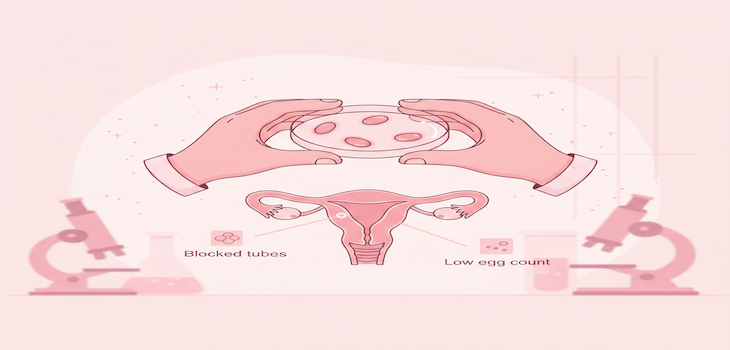
Many patients first hear terms such as blocked fallopian tubes, low egg count, low AMH or reduced ovarian reserve after a fertility evaluation.
These findings can feel worrying, especially when it is not immediately clear what they mean for natural pregnancy, IUI or IVF. You may wonder whether you can still get pregnant naturally, whether one blocked tube is different from both tubes being blocked, whether IUI is still possible, or whether IVF should be considered sooner.
The answer is not the same for every patient. A blocked fallopian tube or low egg count does not automatically mean pregnancy is impossible. However, it does mean the next step should be chosen carefully.
At Janini IVF, a fertility clinic in Delhi, these findings are reviewed together with age, ovulation pattern, semen analysis, hormone levels, ultrasound findings and previous treatment history. This helps decide whether natural conception, IUI, IVF or IVF with ICSI may be more suitable.
In this Clinical Note, our doctors explain when pregnancy may still be possible with one blocked fallopian tube, why IVF is often considered when both tubes are blocked, how low AMH or low egg count can affect treatment timing, and when IUI, IVF or IVF with ICSI may be discussed.
Why Fallopian Tubes Matter When You Are Trying to Conceive
Fallopian tubes play an important role in natural conception because this is where the egg and sperm usually meet.
Each month, when ovulation happens, an egg is released from the ovary. The fallopian tube helps pick up the egg. Sperm then travels through the uterus into the tube, where fertilisation usually takes place. The early embryo then moves through the tube towards the uterus.
This means the fallopian tube is not just a passage. It needs to be open and functioning well.
If one or both tubes are blocked, damaged or filled with fluid, the egg and sperm may not meet properly. This can make natural conception difficult and may change which fertility treatment is most appropriate.
Pregnancy may still be possible with blocked fallopian tubes, but it depends on whether one tube or both tubes are affected.
If one fallopian tube is blocked and the other tube is open and functioning well, pregnancy may still happen through the open tube. In this situation, natural conception, ovulation tracking or IUI may still be discussed, depending on the rest of the fertility assessment.
If both fallopian tubes are blocked, natural conception becomes much more difficult because the egg and sperm may not be able to meet. Treatments such as timed intercourse or IUI usually need at least one open and functioning tube. In this situation, IVF may be considered because it bypasses the fallopian tubes.
If only one fallopian tube is blocked, pregnancy may still be possible through the other tube.
This depends on whether the open tube is functioning well, whether ovulation is happening regularly, whether semen parameters are suitable, and whether there are other factors such as low AMH, reduced ovarian reserve or age-related fertility changes.
In some cases, your doctor may discuss ovulation tracking, ovulation induction or IUI. However, if there are additional fertility concerns, IVF may be discussed earlier.
This does not mean there is no hope. It means the treatment plan should reflect the complete fertility picture, not just one test result.
If both fallopian tubes are blocked, natural conception is much more difficult because the egg and sperm may not be able to meet inside the tube.
In this situation, IUI is usually not suitable because IUI still depends on the fallopian tubes. The sperm is placed inside the uterus, but fertilisation still has to happen inside the tube.
IVF may be considered because fertilisation happens outside the body. The eggs are collected from the ovaries and fertilised with sperm in the laboratory. The embryo is then placed directly into the uterus.
This is why IVF is often used for blocked fallopian tubes. It works around the problem by bypassing the tubes.
Blocked fallopian tubes may happen because of infection, inflammation, scarring, adhesions or fluid collection.
Common causes include previous pelvic infection, sexually transmitted infections such as chlamydia or gonorrhoea, genital tuberculosis, endometriosis, hydrosalpinx, previous pelvic surgery, adhesions, scarring or a previous sterilisation procedure.
Many women do not know they have a tubal block until they are tested for infertility. There may be no clear symptoms. Some patients may have lower abdominal pain, discharge, pain during intercourse or a history of pelvic infection, but in many cases, the first sign is difficulty getting pregnant.
Blocked fallopian tubes are usually diagnosed through fertility tests. Your doctor may advise one or more tests depending on your symptoms, history and previous reports.
HSG test: An HSG test uses dye and X-ray imaging to check whether the fallopian tubes are open. If the dye passes through the tubes, they may be open. If it does not pass through, there may be a blockage.
Sono-salpingography: Sono-salpingography uses a special fluid and ultrasound to assess whether the tubes appear open. It may be used in selected cases and does not involve X-ray radiation.
Laparoscopy: Laparoscopy is a keyhole procedure that allows the doctor to look directly at the uterus, ovaries and fallopian tubes. Dye may also be used during the procedure to check whether the tubes are open. Laparoscopy can also help identify conditions such as endometriosis or adhesions, and in some cases, treatment may be performed during the same procedure.
IVF is not always the only option for blocked fallopian tubes.
If one tube is open and functioning well, and other fertility factors are favourable, natural conception or IUI may still be discussed. This is more likely when ovulation is regular, ovarian reserve is suitable, semen analysis is reassuring and age is not a major limiting factor.
However, if both tubes are blocked, if the tubes are badly damaged, or if hydrosalpinx is present, IVF is often considered a more direct option. This is because IVF does not need the tubes to bring the egg and sperm together. That step happens in the laboratory.
IUI can sometimes be considered if one fallopian tube is open and functioning well. Ovulation also needs to be happening naturally or with medication, and semen parameters need to be suitable.
IUI is usually not suitable if both tubes are blocked, if there is significant tubal damage, if hydrosalpinx is present, if egg count is low, if sperm parameters are not suitable, or if previous IUI cycles have not worked.
In these situations, IVF may be a more direct treatment option because it bypasses the tubes.
Tubal surgery may be discussed in selected cases, but it is not always the preferred option.
Even if surgery opens the tube, the tube may still not work normally. The inside of the fallopian tube has tiny hair-like structures that help move the egg, sperm and embryo. If these structures are damaged, the tube may be open but may not function well.
There may also be a higher risk of ectopic pregnancy after tubal damage or tubal surgery.
For many patients with significant tubal block, IVF may be advised because it bypasses the tubes completely. This can be especially important when age, low egg count, sperm-related factors or previous failed treatments are also part of the picture.
Hydrosalpinx means that a fallopian tube is filled with fluid.
This can happen when the tube is blocked and damaged. In some cases, the fluid may affect the environment inside the uterus and reduce the chance of embryo implantation.
When hydrosalpinx is present, surgery may sometimes be recommended before IVF to remove or treat the affected tube. This is different from routine tubal surgery to reopen the tubes. The purpose is to improve the conditions for IVF and embryo transfer.
If blocked fallopian tubes and low egg count are both present, treatment planning becomes more time-sensitive.
Blocked tubes affect whether the egg and sperm can meet, while low egg count affects how much time and ovarian response may be available for treatment. When both are present, IVF may be discussed sooner because it bypasses the tubes and allows the fertility team to work with the eggs available in that cycle.
For example, if both tubes are blocked, IUI or natural conception may not be suitable because the egg and sperm cannot meet easily. If ovarian reserve is also low, spending many months on options that depend on open tubes may not be helpful.
This does not mean every patient must start IVF immediately. It means the plan should be based on the diagnosis, age, ovarian reserve and overall fertility history.
At a fertility clinic, this assessment helps decide whether continued monitoring, IUI, IVF or IVF with ICSI is more appropriate for the patient’s situation.
IVF may be considered when the fallopian tubes cannot support fertilisation, when ovarian reserve is reduced, or when more than one fertility factor is present.
This may include situations where both fallopian tubes are blocked, one tube is blocked with other fertility factors, hydrosalpinx is present, IUI is unlikely to be suitable, AMH or egg count is low, previous lower-intervention treatments have not worked, there is a sperm-related factor, or age makes time an important consideration.
In IVF, the eggs are collected from the ovaries and fertilised with sperm in the laboratory. The embryo is then transferred into the uterus. This allows treatment to bypass the fallopian tubes.
Low egg count usually means reduced ovarian reserve. This means the number of available eggs may be lower than expected for a patient’s age.
Low AMH is one of the markers doctors use to understand ovarian reserve. However, AMH is not interpreted on its own. It is usually reviewed along with ultrasound findings, antral follicle count, hormone tests, age and previous response to fertility treatment.
Low AMH does not mean pregnancy is impossible. However, it may affect how the ovaries respond to stimulation, how many eggs may be collected in an IVF cycle, how much time should be spent trying naturally or with IUI, and whether IVF should be considered sooner.
This is why low egg count is not just about the number. It is about how that result fits into the wider fertility plan.
Pregnancy may still be possible with low egg count or low AMH, but treatment planning often needs to be more careful.
Doctors look at whether ovulation is happening, whether the tubes are open, whether sperm parameters are suitable, and whether age or time is an important factor.
For some patients, natural attempts or lower-intervention treatment may still be discussed. For others, IVF may be considered sooner so that time is not lost on treatment options that may have a lower chance of success.
If you have been told that your tubes are blocked or your egg count is low, it can help to ask:
Is one tube blocked or are both tubes blocked?
Is the open tube functioning well?
Do I have hydrosalpinx?
Is IUI suitable in my case?
What are my AMH and antral follicle count?
How does my age affect the treatment plan?
Would IVF be more suitable than tubal surgery?
These questions can help you understand why one treatment may be recommended over another.
At Janini IVF, a fertility clinic in Delhi, fertility treatment is planned after reviewing fallopian tube status, ovarian reserve, ovulation pattern, semen analysis, age and previous treatment history.
If you have been told that you have blocked fallopian tubes, low AMH or reduced ovarian reserve, it is natural to have questions about what this means for your chances of pregnancy.
A structured consultation can help clarify whether natural conception, IUI, IVF or IVF with ICSI may be suitable for your situation.
Last reviewed by Dr. Rutvij Dalal on Jun 01, 2026
Your email address will not be published. Required fields are marked *
If you like to have more information, let us connect. Please fill in the form below to learn about your Fertility status or scheduling an appointment with us.