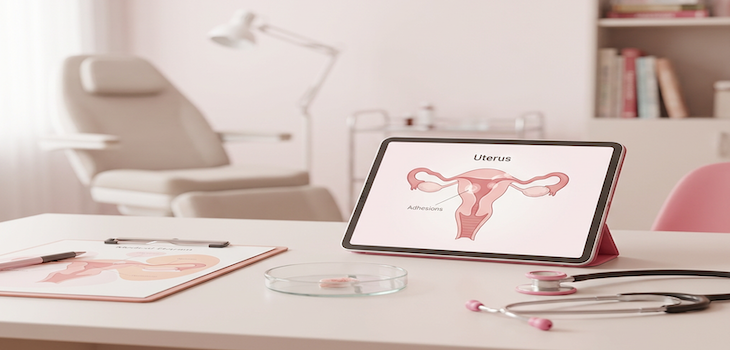
Some patients come to a fertility clinic after being told that the uterine lining looks thin, the uterine cavity may have adhesions, or there may be a history of infection such as tuberculosis. These findings can feel worrying, but they need to be interpreted carefully before deciding whether they affect fertility treatment.
At Janini IVF, findings related to the uterine cavity and endometrial lining are assessed along with your symptoms, menstrual history, previous procedures, infection history and fertility treatment plan.
This page explains what intrauterine adhesions, Asherman’s syndrome and endometrial tuberculosis may mean, and when further evaluation may be needed before IUI, IVF or embryo transfer.
The inside of the uterus is where an embryo is expected to implant. The inner lining of the uterus, called the endometrium, prepares during the menstrual cycle and plays an important role in pregnancy.
For fertility treatment, especially IVF or embryo transfer, it is important to assess whether the uterine cavity is suitable and whether the endometrial lining is developing appropriately.
If there are adhesions, scarring, infection-related changes or damage to the lining, treatment planning may need to be reviewed more carefully. The relevance depends on the extent of the finding and the patient’s overall fertility history.
Intrauterine adhesions are bands of scar-like tissue inside the uterus. They may cause parts of the uterine walls to stick to each other.
Adhesions may develop after infection, previous uterine procedures, curettage, chronic inflammation or tuberculosis. In some patients, they may be mild. In others, they may affect the shape or space of the uterine cavity more significantly.
The relevance of adhesions depends on:
where they are located
how much of the cavity is affected
whether periods have changed
whether the endometrial lining is affected
whether there has been difficulty conceiving
whether there have been previous failed embryo transfers
whether there have been miscarriages
Adhesions are important because they can affect the uterine cavity, which is where implantation needs to take place.
Asherman’s syndrome refers to scarring or adhesions inside the uterus. The term is usually used when intrauterine adhesions are more significant or when they affect the cavity and menstrual pattern.
Some patients with Asherman’s syndrome may notice lighter periods, very scanty bleeding or absence of periods. Others may come for evaluation because of infertility, recurrent pregnancy loss or previous unsuccessful fertility treatment.
Not every adhesion means severe Asherman’s syndrome. The diagnosis and significance depend on the extent of scarring and how the cavity is affected.
This is why the uterine cavity may sometimes need to be assessed directly before deciding the next step.
Endometrial tuberculosis refers to tuberculosis affecting the lining of the uterus. Genital tuberculosis may also affect the fallopian tubes or other reproductive structures.
In fertility evaluation, endometrial tuberculosis may be considered if there is a relevant history, suggestive findings or unexplained infertility where infection-related factors need to be ruled out.
This does not mean every patient with infertility needs to worry about tuberculosis. It means that in selected patients, especially where history or findings suggest it, the fertility specialist may recommend further evaluation.
Endometrial tuberculosis needs careful medical assessment because it may affect the uterine lining, cavity or tubes, depending on the case.
The embryo needs a suitable uterine lining and cavity for implantation. If adhesions, scarring or infection-related changes affect the cavity, the lining may not develop as expected or the space inside the uterus may be altered.
These findings may be relevant in patients with:
difficulty conceiving
very light or absent periods
previous uterine procedures
previous pelvic infection
suspected genital tuberculosis
repeated miscarriage
previous failed IVF or embryo transfer
thin or irregular endometrial lining
unclear uterine cavity findings on scan
The finding itself does not explain everything on its own. It must be interpreted with the full fertility assessment.
Some patients with intrauterine adhesions or Asherman’s syndrome may notice changes in their periods. This may include lighter bleeding, very short periods or absence of periods.
Some patients may have pelvic discomfort or a history of previous infection or uterine procedure. Others may not have clear symptoms and may only discover a problem during fertility evaluation.
Endometrial tuberculosis may also be difficult to recognise without proper assessment. It may not always present in an obvious way.
Because symptoms can vary, it is important to review the patient’s history carefully rather than relying on one finding alone.
Evaluation depends on the suspected condition and the patient’s fertility history.
The fertility specialist may review:
ultrasound findings
menstrual history
previous procedures such as curettage
history of infection or tuberculosis
previous fertility treatment outcomes
endometrial lining thickness and appearance
tubal evaluation where relevant
whether IVF or embryo transfer is being planned
In selected cases, hysteroscopy may be advised. Hysteroscopy allows the doctor to see the inside of the uterine cavity directly. If adhesions are present, the extent can be assessed and treatment may be planned accordingly.
If endometrial tuberculosis is suspected, further medical evaluation may be required before deciding the fertility treatment plan.
Hysteroscopy may be considered when the uterine cavity needs closer evaluation.
This may be relevant if:
intrauterine adhesions are suspected
Asherman’s syndrome is suspected
periods have become very scanty or absent
the endometrial lining is persistently thin
there have been previous failed embryo transfers
recurrent miscarriage has occurred
the scan suggests a cavity-related finding
there is a history of uterine procedure or infection
Hysteroscopy is not required for every patient. It is advised when the clinical situation suggests that seeing the uterine cavity directly may help treatment planning.
In IVF, embryo quality is important, but the uterine cavity and endometrial lining are also important.
If adhesions or scarring affect the cavity, the fertility team may need to evaluate whether the uterus is ready for embryo transfer. In some cases, treatment of adhesions may be considered before transfer. In other cases, the plan may depend on how much of the cavity is affected and whether the lining can develop adequately.
This may be especially relevant when a patient has had previous failed embryo transfers despite apparently good embryos, or when the lining has remained thin or irregular.
The goal is to understand whether the uterine cavity is suitable before proceeding.
If endometrial tuberculosis is suspected or diagnosed, fertility treatment planning must be approached carefully.
The fertility specialist may need to understand whether the infection has affected the endometrial lining, uterine cavity or fallopian tubes. The next step depends on the patient’s reports, symptoms, treatment history and current fertility goals.
In some patients, tuberculosis may be associated with tubal factors. In others, the concern may be the uterine lining or cavity.
This is why endometrial tuberculosis should not be treated as a general label. It needs proper evaluation before deciding whether IUI, IVF or embryo transfer is appropriate.
Intrauterine adhesions, Asherman’s syndrome and endometrial tuberculosis can affect patients differently.
One patient may have a mild adhesion that can be treated. Another may have more significant cavity involvement. One patient may have a history of previous uterine procedure. Another may have infection-related findings. The treatment plan will not be the same for everyone.
A complete fertility assessment helps decide:
whether the finding is mild or significant
whether the uterine cavity is affected
whether the endometrium is developing adequately
whether hysteroscopy is needed
whether infection-related evaluation is required
whether fertility treatment can proceed
whether the plan needs to be adjusted before embryo transfer
This helps avoid both unnecessary worry and missed uterine factors.
At Janini IVF, uterine cavity and endometrial findings are assessed as part of a complete fertility work-up. The focus is not only on identifying the finding, but on understanding whether it affects the patient’s fertility treatment plan.
The team reviews symptoms, scan findings, previous reports, fertility history and treatment goals before advising the next step. In selected cases, hysteroscopy or further evaluation may be recommended to understand the uterine cavity more clearly.
This approach helps plan fertility treatment more carefully, especially before IVF or embryo transfer.
If your reports mention intrauterine adhesions, Asherman’s syndrome, scarring inside the uterus or possible endometrial tuberculosis, the finding should be reviewed in the context of your fertility history.
At Janini IVF, we assess the uterine cavity, endometrial lining, previous reports and treatment history together before deciding whether further evaluation, hysteroscopy or a change in the fertility plan is required.
Can intrauterine adhesions affect fertility?
Yes. Intrauterine adhesions may affect fertility if they change the uterine cavity or interfere with the endometrial lining.
What is Asherman’s syndrome?
Asherman’s syndrome refers to scarring or adhesions inside the uterus, which may affect periods, fertility or implantation.
Can endometrial tuberculosis affect fertility?
Endometrial tuberculosis may affect fertility if it involves the uterine lining, cavity or fallopian tubes.
How are intrauterine adhesions assessed?
Intrauterine adhesions may be assessed with hysteroscopy when the uterine cavity needs direct evaluation.
Last reviewed by Dr. Rutvij Dalal on Sep 01, 2026
Your email address will not be published. Required fields are marked *
If you like to have more information, let us connect. Please fill in the form below to learn about your Fertility status or scheduling an appointment with us.