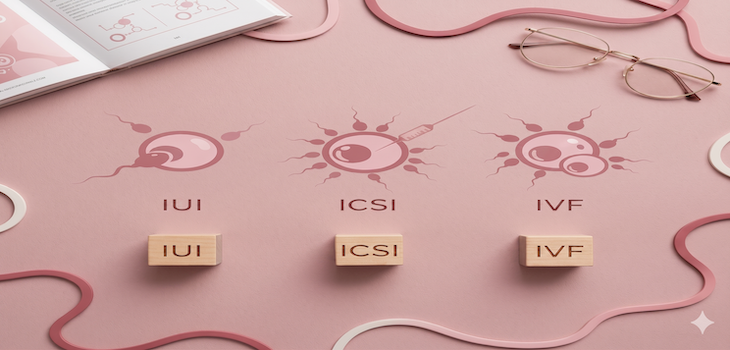
Many patients come across terms like IUI, IVF and ICSI while trying to understand fertility treatment.
They are often explained separately, but when seen together, it can be difficult to understand how they differ and why one may be recommended over another. It is completely understandable to feel unsure at this stage.
In clinical practice, these are not interchangeable options. Each has a specific role, and the choice depends on individual medical factors rather than preference alone.
IUI, or intrauterine insemination, is generally the least complex approach. It involves placing prepared sperm directly into the uterus at the time of ovulation, and may be considered when there are no significant structural concerns.
IVF, or in vitro fertilisation, is a more involved process. Eggs are retrieved from the ovaries, fertilised in a laboratory, and the resulting embryo is transferred into the uterus. This allows greater control over fertilisation and early embryo development.
ICSI, or intracytoplasmic sperm injection, is a specialised form of IVF. In this process, a single sperm is injected directly into the egg. It is typically used in situations where there are concerns related to sperm quality or fertilisation.
For most patients, the key question is not what these treatments are, but which one is appropriate for their situation.
This decision is based on a combination of factors.
If evaluation suggests mild or unexplained infertility, IUI may be considered as an initial approach, especially when time is not a limiting factor.
However, when there are clear barriers to conception — such as blocked fallopian tubes or more advanced endometriosis — IVF is usually recommended, as it helps bypass these limitations.
In cases where sperm parameters are significantly affected, ICSI may be advised within an IVF cycle to support fertilisation more directly.
Age is an important factor in fertility treatment planning.
As ovarian reserve and egg quality change over time, particularly after the mid-30s, the approach to treatment may also change.
For some patients, it may be appropriate to begin with simpler options such as IUI. For others, IVF may be recommended earlier to improve the chances of success within a shorter time frame.
Treatment decisions also take into account what has already been tried.
If IUI cycles have not resulted in pregnancy, moving to IVF may be the next step.
If fertilisation has been a concern in earlier IVF cycles, ICSI may be recommended in subsequent attempts.
Patients often ask whether IVF or ICSI is the “better” option.
In practice, the goal is not to choose the most advanced treatment, but the most appropriate one.
In some situations, starting with IUI may be reasonable. In others, proceeding directly to IVF or IVF with ICSI may offer a more effective pathway.
At Janini IVF, treatment recommendations are based on a detailed clinical assessment, including diagnosis, age, and prior treatment history.
The focus is on selecting an approach that is both appropriate and effective, without unnecessary intervention.
It is common to receive different recommendations and still feel uncertain about what is right in your case.
A structured consultation can help clarify not only the treatment options, but also the reasoning behind them.
For patients exploring fertility treatment in Delhi, consultations at Janini IVF are designed to provide clarity on diagnosis, available treatment options, and the most appropriate next step.
Last reviewed by Dr. Rutvij Dalal on May 01, 2026
Your email address will not be published. Required fields are marked *
If you like to have more information, let us connect. Please fill in the form below to learn about your Fertility status or scheduling an appointment with us.